

Eigenwoningforfait: what it is and how to calculate it | Libero Financieel
Do you own your home? Then the Dutch Tax Administration (Belastingdienst) adds an amount to your income every year: the eigenwoningforfait (notional rental value addition). The idea behind the eigenwoningforfait is that owning a home provides a financial benefit, because you live in your own property and benefit from that. The Belastingdienst taxes that benefit through the eigenwoningforfait. We explain how to calculate it and what it means for your tax return.
Find out how this relates to your mortgage interest deduction
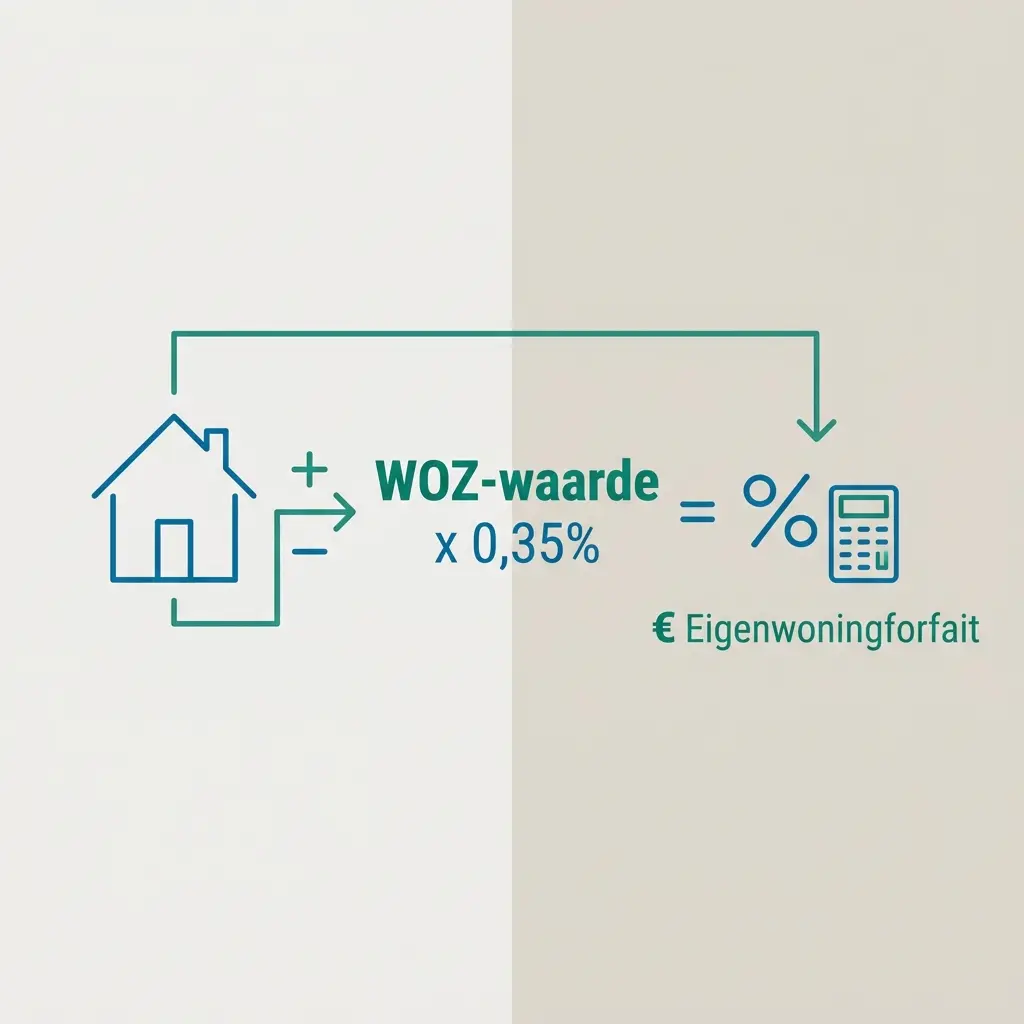
What is the eigenwoningforfait?
The eigenwoningforfait is a fixed percentage of your property's official value (WOZ-waarde) that is added to your income in box 1. The eigenwoningforfait only applies to the property that is your main residence, not to a second home or buy-to-let property. Those fall under box 3 and don't get an eigenwoningforfait.
The eigenwoningforfait is offset against your hypotheekrenteaftrek (mortgage interest deduction). If you pay more mortgage interest than the eigenwoningforfait, you still come out ahead on balance. If you pay little or no mortgage interest anymore, the eigenwoningforfait can start to weigh more heavily, as explained below.
Calculating the eigenwoningforfait with the WOZ value
You calculate the eigenwoningforfait by multiplying your property's WOZ value by the applicable percentage. For most properties, a fixed rate of 0.35% of the WOZ value applies in 2026.
Worked example. Say your property's WOZ value is € 400,000. The eigenwoningforfait then comes to: € 400,000 × 0.35% = € 1,400. This amount is added to your income in box 1. If you pay, say, € 10,000 in mortgage interest that year, your income from your own home is negative on balance: € 1,400 minus € 10,000 is minus € 8,600. You deduct that amount from your income, which is your mortgage interest deduction.
Note: for your tax return, you use the WOZ assessment (WOZ-beschikking) you receive from your municipality in the tax year of your return. That assessment is based on your property's value on the reference date of 1 January of the previous year. Filing your return for 2026? Then you use the WOZ assessment you received at the start of 2026, based on the value a year earlier.
Eigenwoningforfait above the villa threshold: the "villataks"
Does your property have a WOZ value above € 1,350,000 (the villa threshold in 2026)? Then 0.35% no longer applies to the entire amount. The regular rate applies up to the villa threshold, and a much higher rate of 2.35% applies to the part above it. This extra addition is known as the villataks ("villa tax"). The higher your property's WOZ value, the bigger the effect of this surcharge on your taxable income.
Eigenwoningforfait without a mortgage: the Wet Hillen
Have you (almost) paid off your mortgage, or do you pay little mortgage interest? Then the eigenwoningforfait can end up higher than your deductible interest. Without further rules, you would then end up paying tax on a debt-free home on balance. To prevent that, the Wet Hillen exists: a deduction that compensates (part of) the difference between the eigenwoningforfait and your mortgage interest.
Because this scheme has been phased down since 2019, this compensation gets smaller every year and will eventually disappear entirely. The further the phase-down progresses, the more tax you'll pay on the eigenwoningforfait as your mortgage decreases. This is an important point to weigh in if you're considering extra repayments on your mortgage.
When does no or a lower eigenwoningforfait apply?
Moving house within the same year
Buying another property within the same year? Then the eigenwoningforfait is calculated proportionally, based on the number of days each property was your main residence.
First home later in the year
Buying your first home in, say, April? Then the eigenwoningforfait applies from the moment the property becomes your main residence.
New-build during construction
For new-build homes, no eigenwoningforfait applies as long as the property isn't yet your main residence.
Second home
A second home or holiday home falls under box 3. No eigenwoningforfait applies there.
Frequently asked questions about the eigenwoningforfait
How much is the eigenwoningforfait in 2026?
For most properties, a rate of 0.35% of the WOZ value applies in 2026. Does your property have a WOZ value above the villa threshold of € 1,350,000? Then a higher rate of 2.35% applies to the part above it.
Which WOZ value do I use for the eigenwoningforfait?
You use the WOZ assessment you receive from your municipality in the tax year of your return. That assessment is based on your property's value on the reference date of 1 January of the previous year.
Does the eigenwoningforfait apply even if I don't have a mortgage?
Yes, the eigenwoningforfait applies to every owner of a main residence, regardless of whether there's still a mortgage on it. If you have no or a low mortgage debt, the Wet Hillen compensates part of the amount, although that compensation gets smaller every year.
Does the eigenwoningforfait also apply to my second home?
No. A second home or holiday home falls under box 3 (savings and investments) and doesn't get an eigenwoningforfait. Only your main residence counts in box 1.
Does the Belastingdienst fill in the eigenwoningforfait automatically?
Often yes, based on the WOZ value known to the Belastingdienst. It's wise to check this amount against your own WOZ assessment, especially if you moved house during the year.
Eigenwoningforfait and mortgage interest deduction: we work it out for you
The eigenwoningforfait never stands on its own. We work out for you what the eigenwoningforfait, the mortgage interest deduction and any Wet Hillen compensation together mean for your net monthly costs. That way, you know exactly where you stand tax-wise.
Calculate your net monthly costs Plan a free mortgage conversation